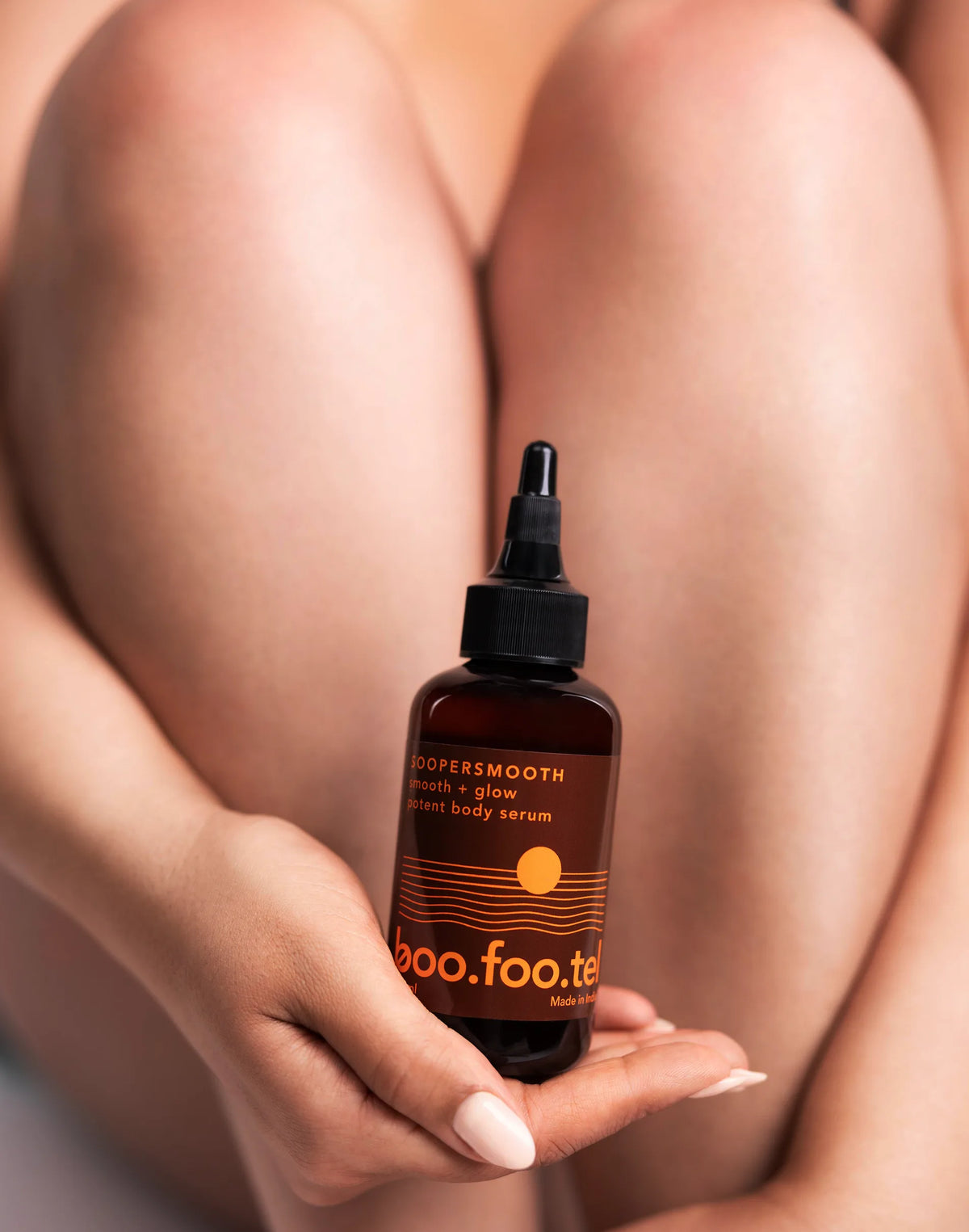
You shaved last night. Your legs felt smooth for about six hours. Now there's a constellation of tiny dark dots running down your shins, and the dress you planned to wear is back in the cupboard.
If that sounds familiar, you've already met strawberry legs. You've probably also met the shelf of products promising to fix them: the body wash, the gritty scrub, the thick "bump-erasing" cream, the serum. They are not interchangeable. Some of them work. Some barely touch the problem. And one of them, on Indian skin especially, can make it look worse.
This is the honest buying guide. What each format does, what the research says, and how to choose.
The quick answer
The best product for strawberry legs is a leave-on chemical exfoliant, ideally a lightweight serum or lotion with glycolic acid and lactic acid, used daily. Body washes rinse off before they can do much. Scrubs irritate hair follicles and can leave marks on deeper skin tones. Plain lotions hydrate but don't clear clogged follicles. Pair a leave-on AHA with smarter shaving and sunscreen, and most people notice smoother skin within about four weeks.
Table of contents
| What are strawberry legs (and why do they linger on Indian skin)? |
| Body wash vs scrub vs lotion vs serum: the comparison |
| Strawberry legs body wash: does it actually work? |
| The best exfoliator for strawberry legs: scrub or chemical? |
| Strawberry legs treatment: what to look for |
| Glycolic acid for strawberry legs (and why lactic acid belongs beside it) |
| Why a leave-on body serum is the smartest buy |
| Soopersmooth: The body serum we built for bumps and marks |
| Your strawberry legs routine, including how to shave |
| Do's and don'ts |
| Key takeaways |
| FAQs |
| References |
What are strawberry legs (and why do they linger on Indian skin)?
Strawberry legs is a description, not a diagnosis. It's the name for tiny dark or reddish dots on the legs that look like the seeds on a strawberry. Behind those dots are hair follicles that have become clogged, inflamed or plugged.
There are four usual suspects, and many of us have more than one at once:
|
Cause |
What it looks and feels like |
The giveaway |
|
Clogged follicles (open comedones) |
Flat dark dots; skin feels smooth |
Worse after shaving. Oil and dead skin oxidise in the open follicle, exactly like a blackhead [12] |
|
Ingrown hairs and razor bumps |
Small raised bumps, sometimes red or tender |
You can sometimes see a curled hair under the skin |
|
Keratosis pilaris (KP) |
Rough, sandpapery bumps, often on thighs and upper arms too |
Feels like permanent goosebumps; flares in dry weather [1] |
|
Folliculitis |
Red, itchy or sore bumps, sometimes with pus |
Inflamed or infected follicles, often after shaving or waxing [12] |
KP alone is remarkably common. It affects an estimated 50 to 80 percent of adolescents and up to 40 percent of adults, and it's linked to a weaker skin barrier and dry skin [1]. So if your mother had "chicken skin" on her arms, there's a reason you might too.
Why it lingers longer on Indian skin
Here's the part most Western guides skip. On medium to deep skin tones, any inflammation in the follicle can leave behind post-inflammatory hyperpigmentation (PIH): a brown mark that outlasts the bump itself. PIH occurs more often and more intensely in darker skin, and one study in Singapore found it was more common among Indian and Malay patients than Chinese patients [7]. Untreated, these marks can take months to years to fade [7].
That changes the brief. For Indian skin, the right product has to clear the follicle and fade the marks, without causing new irritation along the way. Keep that in mind as we go through the formats.

Body wash vs scrub vs lotion vs serum: the comparison
The single biggest factor is contact time: how long the active ingredient actually stays on your skin. A leave-on product works for hours. A wash-off product works for the length of a shower.
|
Format |
Time on skin |
What it does well |
Where it falls short |
Verdict for strawberry legs |
|
Body wash |
Under a minute, then rinsed |
Cleans; acid washes give a light head start |
Too little contact time to clear plugged follicles on its own |
Supporting step, not the treatment |
|
Physical scrub |
A minute of friction |
Instant softness, temporarily |
Friction irritates follicles; risk of new dark marks on Indian skin |
Skip, or use very rarely |
|
Lotion or cream |
Hours (leave-on) |
Hydration; acid or urea formulas also exfoliate |
Plain moisturisers don't clear follicles; rich creams can feel heavy in humidity |
Good if it contains an exfoliating active |
|
Serum |
Hours (leave-on) |
Concentrated actives, light texture, absorbs fast |
Usually needs sunscreen in the day; not for very sensitive skin |
Best fit for most Indian skin |
In short: the formats that stay on your skin and exfoliate chemically are the ones that move the needle. Here's the detail on each.
Strawberry legs body wash: does it actually work?
A body wash can help, but it can't do the job alone. Even a wash with salicylic acid or AHAs sits on your legs for less than a minute before it goes down the drain. That's a light polish, not a treatment.
Where a body wash earns its place:
• As a gentle cleanser. Dermatologists recommend a mild, fragrance-free cleanser for skin prone to KP, because harsh soaps add to the dryness that makes bumps worse [8].
• As a pre-shave step. Washing first softens hair and clears surface oil before the razor goes in.
• As a supporting exfoliant. A salicylic acid wash two or three times a week can complement a leave-on treatment, particularly if your dots are mostly clogged follicles.
What to avoid: very hot showers and strongly perfumed, foaming washes that leave your legs feeling tight. Tight means stripped, and stripped skin plugs up faster.
Bottom line: buy a strawberry legs body wash for comfort and cleanliness. Don't buy it expecting the dots to disappear.
The best exfoliator for strawberry legs: scrub or chemical?
Chemical, every time. Exfoliation is the right idea; scrubbing is the wrong way to do it.
Many of us grew up with the loofah, the pumice and the weekend ubtan ritual, so a scrub feels like the obvious fix. But the American Academy of Dermatology specifically advises against scrubbing skin with KP, because it irritates the skin and tends to make the bumps worse [8]. Mayo Clinic says the same: vigorous scrubbing, or trying to dig out follicle plugs, can aggravate the condition [10].
On Indian skin there's a second cost. Friction is a form of inflammation, and inflammation is what triggers post-inflammatory hyperpigmentation [7]. Scrub hard enough, often enough, and you can trade bumps for brown spots.
How a chemical exfoliator works instead
Alpha hydroxy acids (AHAs) like glycolic and lactic acid loosen the bonds that hold dead skin cells together, so they shed evenly rather than being sanded off [1]. That matters for strawberry legs because the problem sits at the follicle opening, where keratin and oil pile up. A scrub polishes the surface around the follicle. A chemical exfoliant softens the plug itself [1].
|
|
Physical scrub |
Chemical exfoliator (AHA) |
|
How it works |
Friction from grains or a glove |
Acids dissolve the "glue" between dead cells |
|
Reaches the follicle plug |
Barely |
Yes, softens keratin build-up |
|
Risk of irritation and marks |
Higher, especially on deeper skin tones |
Lower when used as directed |
|
How often |
Easy to overdo |
Daily, in a leave-on format |
|
Extra benefits |
Instant smoothness |
Smoother texture, more even tone over time |
If you love the ritual of a scrub, keep it gentle and occasional, never on freshly shaved skin, and never on the same day as an acid. But if the goal is to get rid of strawberry legs, your exfoliator should be chemical and leave-on.

Strawberry legs treatment cream and lotion: what to look for
A strawberry legs treatment cream works only if it contains a keratolytic, an ingredient that breaks down built-up keratin. A plain moisturiser keeps skin soft, which helps, but it won't clear clogged follicles.
The ingredients with the strongest evidence for bumpy, KP-type skin are [1]:
• Lactic acid (5 to 12%). In a 12-week split-body study, 10% lactic acid reduced KP lesions by 66%, with improvement visible by week four.
• Salicylic acid. The same study found 5% salicylic acid reduced lesions by 52%. It's oil-soluble, so it suits oilier, congestion-prone legs.
• Urea (10 to 20%+). Hydrates at lower strengths and exfoliates at higher ones. A 20% urea cream improved texture within one week in a small study.
• Glycolic acid. Corrects abnormal keratin build-up in the follicle and supports pigment turnover. More on this below.
Two things to check before you buy:
1. Texture for your climate. Dermatologists suggest an oil-free cream or ointment for KP to avoid clogging pores [8]. In a Mumbai or Chennai summer, a heavy butter can sit on the skin and feel sticky, so lighter textures are easier to use every day.
2. Something for the marks. Most bump creams are built for texture only. If you also have dark dots or leftover spots, look for brightening ingredients too.
A caveat worth knowing: the evidence for every topical KP treatment comes from small, short studies, and benefits last only as long as you keep using the product [1]. Consistency beats intensity.
Glycolic acid for strawberry legs (and why lactic acid belongs beside it)
Glycolic acid is one of the most useful ingredients for strawberry legs because it targets three of the four causes at once: clogged follicles, keratin plugs and ingrown hairs.
What glycolic acid does
• Clears the follicle. It's the smallest AHA, so it works efficiently on dead skin build-up. Reviews describe it correcting abnormal keratinisation in the follicle duct and loosening old cells [1, 2].
• Helps with ingrown hairs. In two placebo-controlled trials, a glycolic acid lotion was significantly more effective than placebo at treating razor bumps, and let participants keep shaving daily [3]. Those trials were on the beard area, but the mechanism, hair curling back into the skin after shaving, is the same one behind many dark dots on the legs.
• Supports even tone. Glycolic acid also facilitates melanin turnover, which is why it's used for follicular pigmentation as well as texture [1].
What strength?
In-clinic glycolic peels for KP use 50 to 70% [2]. That's a dermatologist's tool. At home, a daily leave-on body product in the single digits is the practical range: strong enough to exfoliate, gentle enough for everyday use.
Why lactic acid belongs in the same bottle
Lactic acid is the gentler AHA with a bonus: it's a natural part of your skin's own moisturising factor, so it exfoliates and hydrates at the same time [1]. KP is tied to dry, barrier-impaired skin, so that dual action matters [1]. Glycolic brings the precision; lactic softens the edges. Together they make daily exfoliation more comfortable.
The non-negotiable: sun protection
AHAs make skin more sensitive to UV. In FDA-sponsored studies, four weeks of AHA use increased sensitivity to UV reddening by 18%, and the effect faded within a week of stopping [6]. On legs that see the sun, sunscreen isn't optional. On Indian skin, UV exposure also darkens the very marks you're trying to fade [7].
Why a leave-on body serum is the smartest buy
A body serum combines what each of the other formats does well and drops what they do badly. It stays on the skin for hours like a cream. It's light enough to use twice a day in humid weather. And it can carry several actives at once, so one step handles bumps, marks and hydration.
That last point is the one that matters most for Indian skin. Clearing the follicle is half the job. The other half is fading the dark dots and leftover spots, and that calls for brightening ingredients alongside the exfoliants:
• Niacinamide reduces visible pigment by limiting how much melanin is transferred to surface skin cells. In the landmark study, it cut melanosome transfer by 35 to 68% in lab models and significantly reduced hyperpigmentation versus a placebo moisturiser after four weeks [4].
• Vitamin C is the skin's most abundant antioxidant and has antipigmentary effects, alongside its role in protecting against UV damage [5].
• Azelaic acid and its derivatives belong to the group of tyrosinase inhibitors used to treat post inflammatory hyperpigmentation [7].