If you’re trying to figure out how to remove a tan from face and body for Indian skin — and nothing has worked — this is why.
If you've tried lemon juice, besan, curd masks, and every de-tan cream at the chemist — and the tan is still there — you're not failing. The product is failing you.
Indian skin doesn’t tan the way most Western skincare content describes. Our melanin behaves differently, our UV exposure is higher, and most “de-tan” products are not built for this biology.
This guide breaks down tan removal for Indian skin — what actually works, what doesn’t, and how long it realistically takes. No overpromising.

Inside this guide
- Why a Tan is Harder to Remove in Indian Skin
- Types of Tan in Indian Skin (Know What You’re Treating)
- Best Ingredients for Tan Removal in Indian Skin
- Tan Removal Routine for Face & Body (Indian Skin)
- Area-by-Area: Tan Removal Guide
- Myths That Are Actually Making Your Tan Worse
- Realistic Tan Removal Timeline
- FAQs
Why a Tan is Harder to Remove in Indian Skin
Indian skin falls between Fitzpatrick Types III and V on the phototype scale. What this means, practically, is that we have significantly more melanin than lighter skin types — and melanin is the key to understanding why your tan is stubborn.
When UV rays hit your skin, your melanocytes (the cells that produce melanin) go into overdrive. They flood the skin with pigment as a protective response. In lighter skin, this shows up as a burn. In Indian skin, it shows up as a deep, lasting tan. Our skin's defence mechanism is more aggressive — and that's actually a feature, not a bug. But it means our pigmentation is harder to shift.
The science in plain language: Your tan isn't just a surface layer of colour. It's melanin that has been distributed through the epidermis and sometimes into the upper dermis. Surface-level products only reach the top layer. Effective de-tan treatment has to penetrate deeper — which is why proper skincare actives outperform home remedies every time.
Add to this India's near-year-round UV intensity, high humidity, pollution, and the fact that most Indians spend significant time outdoors during peak UV hours (10am–4pm) — and you have a recipe for chronic, layered pigmentation that simply can't be scrubbed away.
Types of Tan in Indian Skin (Know What You’re Treating)
Not all “tan” is the same. This is where most people go wrong. There are three distinct types of pigmentation that Indians commonly mistake for "just a tan".

Surface tan
This is the easiest to treat. It's the fresh darkening you see after a beach trip, a commute, or outdoor sport. It sits in the outermost skin layer and responds well to gentle exfoliation, vitamin C, and consistent SPF. You should see results in 2–4 weeks.
Deep or chronic tan
This has built up over months or years of cumulative UV exposure. The pigment has settled into deeper skin layers. It needs sustained treatment with exfoliating acids and brightening actives — think 6–10 weeks minimum.
Post-inflammatory hyperpigmentation (PIH)
This looks like a tan but is actually a different beast. It occurs when inflammation — from acne, friction, or irritation — triggers excess melanin production. Dark patches after pimples, dark underarms from friction, dark inner thighs from chafing — this is PIH. The treatment is similar but requires more focus on anti-inflammatory ingredients.
Melasma
Often confused with tan, melasma is hormonal and sits in the deeper dermis. It appears symmetrically on the face — cheeks, forehead, upper lip — often triggered by pregnancy, hormonal contraception, or sun exposure. It needs a dermatologist's assessment. The routine below will help, but melasma typically requires prescription-grade treatment.
Quick test: Press a finger on the dark patch. If the colour returns immediately when you release, it's likely a surface tan or PIH. If the area feels flat and the colour is patchy or asymmetrical on your face, consult a dermatologist — it may be melasma.

Best Ingredients for Tan Removal in Indian Skin
Forget the turmeric-and-curd masks your grandmother swore by (more on that in the myths section). Here are the actives with actual science behind them, specifically relevant to how Indian skin processes pigmentation.
Niacinamide
BEST ALL-ROUNDERBlocks the transfer of melanin from melanocytes to skin cells. It's anti-inflammatory, improves the skin barrier, and is one of the gentlest actives available — ideal for daily use, face and body. Especially useful for PIH and friction-related darkening.
Vitamin C
ANTIOXIDANT + BRIGHTENERInterrupts melanin synthesis at the tyrosinase level. Also neutralises free radicals from UV and pollution damage. Most effective in a stabilised form (ethyl ascorbic acid, ascorbyl glucoside) which is gentler on Indian skin than pure ascorbic acid.
Alpha Arbutin
DEPIGMENTINGA naturally derived tyrosinase inhibitor — far safer than hydroquinone for long-term use on Indian skin. Works steadily over 8–12 weeks to reduce dark spots without the irritation risk.
Glycolic Acid
EXFOLIANTAn AHA that accelerates cell turnover, removing the uppermost pigmented skin cells to reveal fresher skin below. Start with a low concentration (5–7%) to avoid causing the very PIH you're trying to treat. Always follow with SPF.
Lactic Acid
GENTLE EXFOLIANTA milder AHA — ideal for sensitive Indian skin or for use on body areas like the underarms, inner thighs, and neck where the skin is thinner. Also hydrating, which makes it kinder for daily use.
Kojic Acid
BRIGHTENINGDerived from fermented rice. A potent tyrosinase inhibitor — effective, but can cause irritation on sensitive skin. Works best in combination with niacinamide to offset potential sensitivity.
The golden rule for Indian skin: Exfoliation without SPF is pointless — and can make pigmentation worse. Actives like glycolic acid and vitamin C make the skin more photosensitive. If you’re not using sunscreen, you are re-tanning faster than you’re correcting. SPF 50+ is non-negotiable.

Tan Removal Routine for Face & Body (Indian Skin)
Here's a complete morning and evening routine built around tan removal. Follow this consistently for at least 6 weeks before expecting visible results.
Morning Routine
1. Gentle cleanser
(pH-balanced, non-stripping)
2. Vitamin C serum
Brightens + protects
3. Niacinamide serum
Reduces pigment transfer
4. Moisturiser
Supports skin barrier
5. SPF 50+ (non-negotiable)
Reapply every 2–3 hours outdoors
Evening Routine
1. Cleanse (double cleanse if needed)
2. Exfoliating acids (2–3x/week)
Glycolic or lactic acid
3. Niacinamide (on non-exfoliation nights)
4. Moisturiser
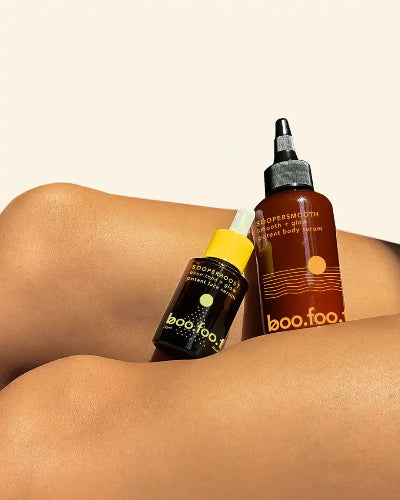
For body care, using a targeted exfoliating + brightening body serum (like Soopersmooth) can significantly speed up results — especially for areas like arms, neck, and thighs where tan builds up more stubbornly.
Area-by-Area: Tan Removal Guide
Indian tan doesn't affect all areas equally. Here's how to adjust your approach for the most commonly darkened zones.
 Face
Face
The most UV-exposed area. Use the full routine above. Vitamin C in the morning and lactic acid (gentler than glycolic) at night works well for sensitive facial skin.
Neck & Chest
Often darker than the face from chronic sun exposure. Use the same actives as your face, but avoid strong glycolic acid — the neck skin is thinner. Niacinamide-based body serum is ideal here.
Back & Shoulders
Hard to reach but responds well to treatment. An AHA-based + niacinamide serum used regularly after the shower, is the most practical daily approach.

Underarms
Often PIH from friction and hair removal, not UV tan. Lactic acid and niacinamide, applied gently, works well. Avoid harsh scrubbing — it makes this worse. Switch to gentle hair removal methods.
Arms & Hands
Common "tan line" zone. The skin here is more resilient. You can use glycolic acid at higher concentrations (8–10%). Apply SPF to hands daily — they're constantly sun-exposed and never protected.
Between fingers & toes
Often missed. These areas can show dramatic tan lines. Vitamin C serum applied daily fades these patches well.

Elbows & Knees
Skin here is thick and rough, so needs more exfoliation. Urea-based moisturisers help soften the texture, while glycolic acid targets the dark colour. Takes the longest — 10–16 weeks.
Inner Thighs
Almost always PIH from friction (chafing) rather than UV. Lactic acid serum + niacinamide, applied daily. Reduce friction with anti-chafe products and loose clothing. Avoid scrubbing.
Legs & Feet
Tan on lower legs is very common from sandal wearing. AHA body exfoliant 2x/week, followed by niacinamide body serum. Apply SPF to feet and ankles if wearing sandals outdoors.
Myths That Are Actually Making Your Tan Worse
Realistic Tan Removal Timeline
Follow this consistently for 6–12 weeks.
The most common reason people give up on a routine is expecting it to work faster than it biologically can. Here's what a real, consistent treatment timeline looks like for Indian skin:
Week 1–2: Skin adjustment
No visible results yet — don't panic. Your skin is getting used to actives. You may notice slight purging or dryness. Moisturise more, and don't stop SPF.
Week 3–4: Surface tan begins fading
Fresh, superficial tan starts visibly lifting. Skin texture improves. This is when most people think "it's working" — and stop. Don't. You've only addressed the top layer.
Week 5–8: Deeper pigmentation responds
Your skin cell turnover cycle is roughly 28 days. You're now on your second full cycle with actives. Deeper tan layers begin to lift. Dark patches become less defined.
Week 9–12: Significant visible change
Even chronic tan shows meaningful improvement. PIH from old acne or friction starts to fade. This is the result most people see in clinical studies with AHA + niacinamide combinations.
Week 12+: Maintenance
You've done the work. Now protect it. One lapse in sun protection can set you back weeks. The routine doesn't stop — it just becomes less intensive.