

You know the moment. You're trying on a sleeveless blouse, lift your arm, and pause. 

If you've ever typed "why are my underarms dark" into Google, consider this your sign to stop scrubbing. Dark underarms are one of the most common concerns on Indian skin, and they're almost never about how clean you are. They're about friction, hair removal, heat and how stubbornly melanin-rich skin responds to all three.

Table of Contents

Why underarms get dark in the first place
Bumpy underarms and "strawberry skin"
The ingredients that actually fade underarm pigmentation
Best Body Serum for dark underarms
Do's and Don'ts
When it's worth seeing a dermatologist
Key Takeaways
FAQs


Dark underarms causes: razor, deodorant and fitted fabric, the everyday sources of underarm friction

Why Underarms Get Dark in the First Place

Think about your underarms' daily life. They sit in a warm, damp fold, rub against fabric all day, get shaved or waxed, then coated in deodorant and sealed under a fitted kurta in 34-degree humidity. That's a lot to ask of such delicate skin.

Every one of those small irritations tells your skin to protect itself, and on deeper skin tones, protection looks like extra melanin. A 2025 systematic review found that underarm pigmentation is more common than pigmentation on other parts of the body for exactly this reason: friction, shaving, hair plucking, deodorants and, ironically, harsh whitening products all keep the area in a low-level state of irritation [1].

Then there's buildup: dead skin, sweat and product residue make the area look duller than it really is.

And sometimes the cause runs deeper. Darker, thicker skin with a velvety feel can be acanthosis nigricans, which is most often linked to insulin resistance, PCOS or type 2 diabetes [2]. More on that below.

Bumpy Underarms and "Strawberry Skin"

If your underarms look dotted rather than simply dark, hair removal is usually behind it. Shaving can inflame hair follicles and trap ingrown hairs, and as those bumps heal they often leave small dark spots, the same "strawberry skin" effect people notice on their legs [3]. Stubble under the surface adds its own shadow.


Ingredients for dark underarms: glycolic acid, lactic acid, niacinamide and vitamin C serum textures

The Ingredients That Actually Fade Underarm Pigmentation

Underarm pigmentation rarely has a single cause, so it rarely has a single fix. The smartest approach layers ingredients that work in different ways.

Glycolic and lactic acid: the resurfacers. These alpha-hydroxy acids loosen the bonds between dull, pigmented surface cells so they shed more evenly, which softens both darkness and roughness [4]. Lactic acid is the gentler, more hydrating of the two, which matters on sensitive skin.

Niacinamide: the pigment interrupter. Niacinamide works by reducing how much pigment is passed from melanin-producing cells to the skin's surface [5]. It's one of the few ingredients tested specifically on underarms: in a randomised, placebo-controlled trial, 4% niacinamide visibly lightened underarm pigmentation over nine weeks [6].

Vitamin C: the brightener. Vitamin C (L-ascorbic acid) interrupts the enzyme tyrosinase, a key step in melanin production, and acts as an antioxidant that helps calm the inflammation behind pigmentation [7]. Over time, it helps fade existing dark patches.

Hyaluronic acid: the comfort layer. Skin that's shaved, sweaty and treated with actives needs hydration to stay calm. Hyaluronic acid delivers it without heaviness.

This is a slow, steady process. Expect gradual change over weeks, and protect your progress by easing up on whatever caused the irritation.
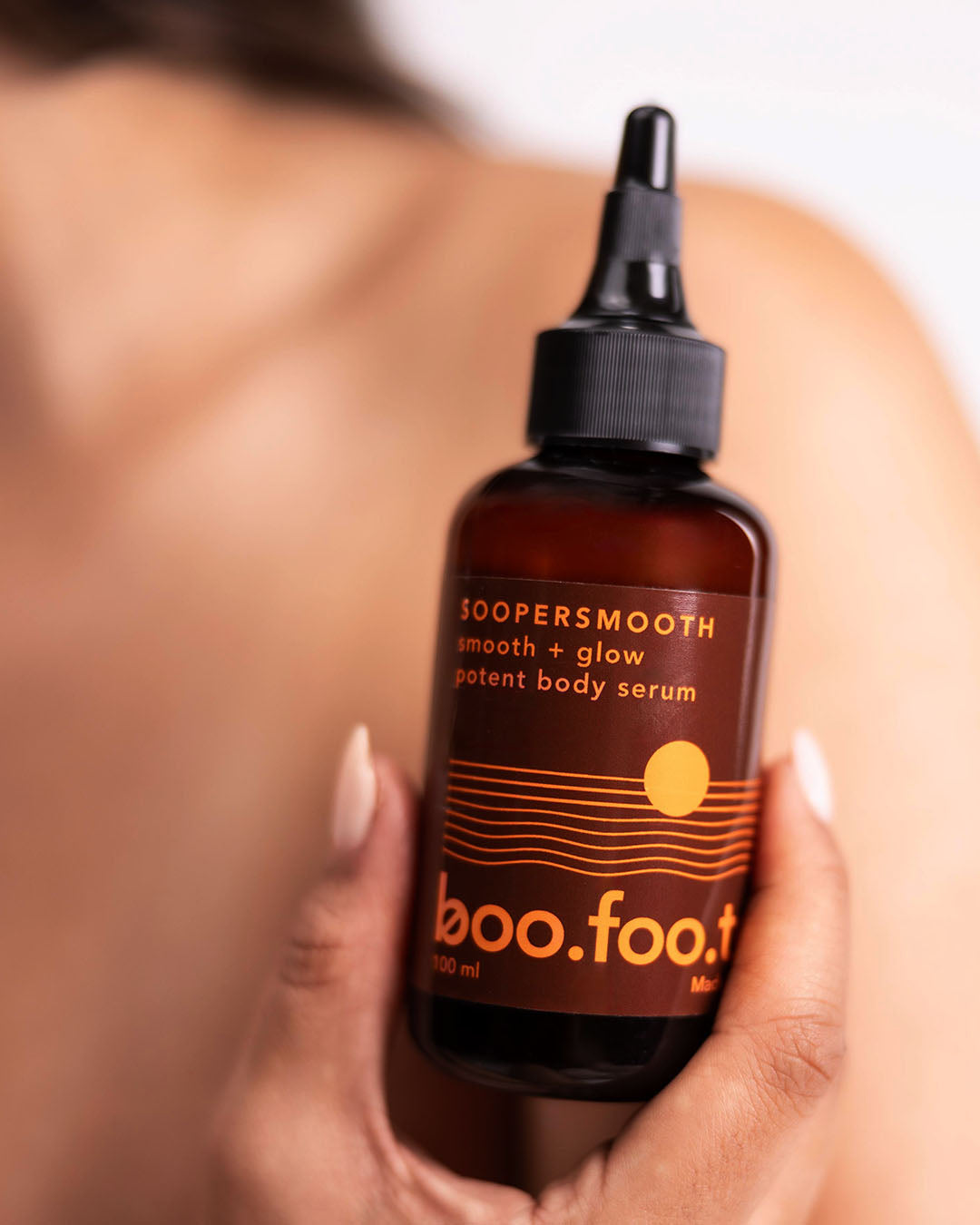
Best Body Serum for Dark Underarms: Boofootel Soopersmooth

What's inside, and why it matters for underarms

  • Glycolic and lactic acid gently clear the rough, pigmented buildup behind darker, bumpier underarms
  • Niacinamide, the ingredient with the strongest underarm-specific research, reduces pigment transfer
  • Vitamin C targets melanin production to help fade existing patches
  • Hyaluronic acid and glycerin keep freshly shaved, sensitive skin hydrated and calm
  • Coconut alkanes give a featherlight, non-greasy finish that suits humid Indian weather, so nothing sits heavy in a warm fold

Do's and Don'ts: 

  • Do's

    ✔️ Shave with a sharp blade, in the direction of hair growth, with a gel or foam

    ✔️ Use a chemical exfoliant rather than a scrub

    ✔️ Choose breathable cotton and looser fits on humid days

    ✔️ Patch-test new products on a small area first

  • Dont's

    ❌ Rub on lemon or baking soda; both irritate thin underarm skin

    ❌ Scrub hard with gritty exfoliators or loofahs

    ❌ Apply acids on freshly shaved or waxed skin

    ❌ Pick at bumps or ingrown hairs

    ❌ Chase "whitening"; aim for calm, even-toned skin instead

When to See a Dermatologist

See a dermatologist if the bumps are red, painful, itchy, filled with pus or spreading.
That points to folliculitis, which may need prescription treatment rather than skincare [12].

Key Takeaways

  • Dark underarms are usually your skin's response to friction, shaving and product irritation, not a hygiene issue.
  • Bumpy, dotted underarms often point to ingrown hairs or inflamed follicles from shaving.
  • Layering glycolic acid, lactic acid, niacinamide and vitamin C works on surface buildup, new pigment and existing dark patches at once.
  • Gentle, consistent care beats harsh, fast fixes.
  • Velvety, spreading darkness needs a dermatologist.

FAQs

Why are my underarms dark even though I keep them clean?

Because cleanliness isn't the cause. Friction, hair removal and product irritation trigger extra melanin, especially on deeper skin tones [1].

Does shaving cause dark underarms?

It can. Repeated razor irritation encourages pigmentation, and stubble under the skin adds a visible shadow [1, 3].

Does vitamin C help dark underarms?

Yes. Vitamin C slows melanin production and calms inflammation, which helps fade existing patches over time [7].

How long does it take to lighten dark underarms?

Expect gradual change; in research, niacinamide showed visible results over about nine weeks [6].

Can dark underarms be a sign of diabetes?

Sometimes. Velvety darkening in body folds can signal insulin resistance, so speak to your doctor [2].

References 

  1. Vahabi SM, et al. Axillary Hyperpigmentation Treatment: A Systematic Review of the Literature. J Cosmet Dermatol. 2025;24(8):e70418. https://pmc.ncbi.nlm.nih.gov/articles/PMC12371607/
  2. Medical News Today. Dark underarms: Causes, treatment, and prevention. https://www.medicalnewstoday.com/articles/322860
  3. Yahoo Lifestyle. How to Get Rid of Strawberry Skin, According to Dermatologists. https://www.yahoo.com/lifestyle/rid-strawberry-skin-according-dermatologists-140000697.html
  4. Sharad J. Glycolic acid peel therapy – a current review. Clin Cosmet Investig Dermatol. 2013;6:281-288. https://pmc.ncbi.nlm.nih.gov/articles/PMC3834700/
  5. Hakozaki T, et al. The effect of niacinamide on reducing cutaneous pigmentation and suppression of melanosome transfer. Br J Dermatol. 2002;147(1):20-31.
  6. Castanedo-Cázares JP, et al. Topical niacinamide 4% and desonide 0.05% for treatment of axillary hyperpigmentation: a randomized, double-blind, placebo-controlled study. Clin Cosmet Investig Dermatol. 2013. https://pmc.ncbi.nlm.nih.gov/articles/PMC3552481/
  7. Telang PS. Vitamin C in dermatology. Indian Dermatol Online J. 2013;4(2):143-146. https://pmc.ncbi.nlm.nih.gov/articles/PMC3673383/

Written by

Delara Lalwani

Delara started Boofootel because she couldn't find a single skincare brand that was built around Indian skin. Its tone, its climate, its concerns. Not adapted for it. Not marketed to it. Actually built for it. So she did it herself.

She writes about skin science the way she wishes someone had explained it to her — clearly, honestly, without the jargon.